The Core Distinction: Repairs vs Capital Improvements
The ATO draws a clear line between two types of expenditure on an investment property, and the kitchen renovation category you fall into determines how — and when — you can claim.
Repairs and Maintenance (Immediately Deductible)
Repairs are generally deductible in the same financial year in which the expense is incurred. To qualify as a repair, the work must restore an asset to its original condition without improving it beyond its original state.
Examples of immediately deductible kitchen work include:
- Replacing a broken benchtop with a like-for-like material
- Repairing a damaged splashback
- Fixing a faulty cabinet hinge or broken drawer runner
- Repainting existing kitchen cabinetry to the same standard
Capital Improvements (Deductible via Depreciation)
A renovation that upgrades or improves the kitchen beyond its original state is treated as a capital improvement. This means you cannot claim the full cost in the year of expenditure; instead, you claim it progressively over time through the ATO’s capital works depreciation provisions.
Capital works deductions (Division 43) apply to the structural components of a renovation at a rate of 2.5% per annum over 40 years, meaning a $40,000 kitchen renovation generates an annual deduction of $1,000 over that period.
Plant and Equipment Depreciation (Division 40)
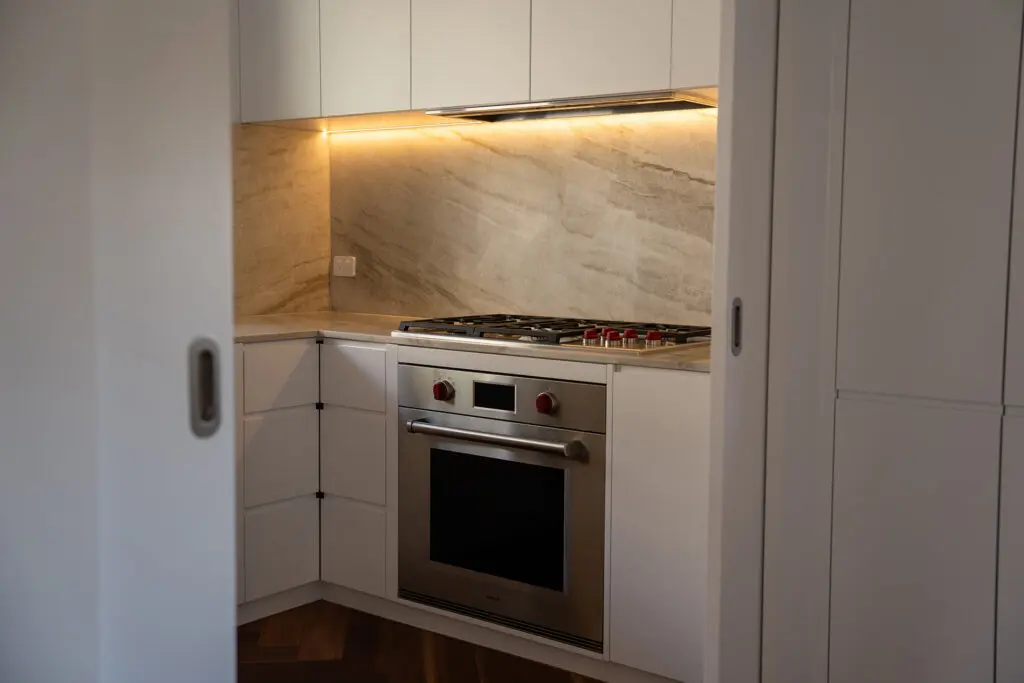
| Kitchen Item | ATO Effective Life | Diminishing Value Rate |
|---|---|---|
| Dishwasher | 10 years | 20% |
| Range hood | 12 years | 16.67% |
| Oven / cooktop | 12 years | 16.67% |
| Refrigerator | 12 years | 16.67% |
| Microwave | 10 years | 20% |
| Kitchen blinds | 10 years | 20% |
Timing Your Renovation: Why It Matters for Tax
The financial year in which your renovation is completed affects which year’s tax return includes the capital works deduction. Renovations completed before 30 June allow you to claim a partial year in the current financial year; those completed after 1 July begin depreciating in the following year.
For investors planning a kitchen renovation in 2025–26, engaging your kitchen designer early — ideally in Q1 — gives the best chance of having the renovation completed and commissioned before year end.
The Value of a Quantity Surveyor’s Report
For investment property renovations above $10,000, a quantity surveyor’s depreciation schedule is strongly recommended. These reports, which typically cost $500–$800, provide a comprehensive breakdown of every depreciable element in your renovation — maximising your annual deductions and providing documentation the ATO requires.
Most Melbourne accountants working in property investment will recommend obtaining a depreciation schedule as standard practice; the cost is itself tax-deductible.
Choosing the Right Kitchen Specification for an Investment Property
From a pure ROI perspective, investment property kitchen renovations benefit from a different specification philosophy to owner-occupied homes:
- Durability over aesthetics — laminate and vinyl wrap cabinetry offers excellent longevity at lower cost
- Neutral colour palette — maximises appeal across the broadest possible renter demographic
- Easy-clean surfaces — consider gloss finishes, ceramic tiles, and sealed stone over porous materials
- Quality appliances on a mid-range budget — Bosch, Westinghouse, or Smeg offer a balance of reliability and price
Direct Kitchens has designed and installed kitchens in investment properties across Melbourne’s eastern and northern suburbs for over 38 years. Our team understands the different priorities of investment versus owner-occupied renovations and can guide your specification accordingly.
Common Mistakes Melbourne Property Investors Make
- Claiming the full renovation cost as a repair when it clearly constitutes an improvement — this is an audit risk
- Failing to obtain a depreciation schedule and underclaiming over many years
- Over-specifying the kitchen for the rental market (a $90,000 kitchen in a $600/week rental does not generate proportional return)
- Not keeping itemised invoices — the ATO requires detailed documentation for all capital works claims
The Direct Kitchens Difference
Because Direct Kitchens manufactures in-house at our Bayswater factory, we can offer custom cabinetry at a quote (once design and materials have been decided on) who assume custom means out of reach. There are no wholesaler margins, no overseas supply chain delays, and no compromises on specification.
Our design team works across all three Melbourne showrooms — Blackburn, Moonee Ponds, and Bayswater — and can provide a scope of works within days of your initial consultation.
Disclaimer: All tax information in this article is general in nature and is current as at mid-2026. Tax laws and ATO rulings are subject to change. This article does not constitute financial, accounting, or legal advice. Readers should seek independent advice from a registered tax agent or the ATO before making investment or renovation decisions.